
Programme
Overview of the symposium
Reception on the evening of Mon 29th June (held in the Aula Maxima, UCC).
Conference talks will run from Tues 30th June until Thurs 2nd July (3 days of talks and posters). All conference talks will take place in the Brookfield Complex of UCC.

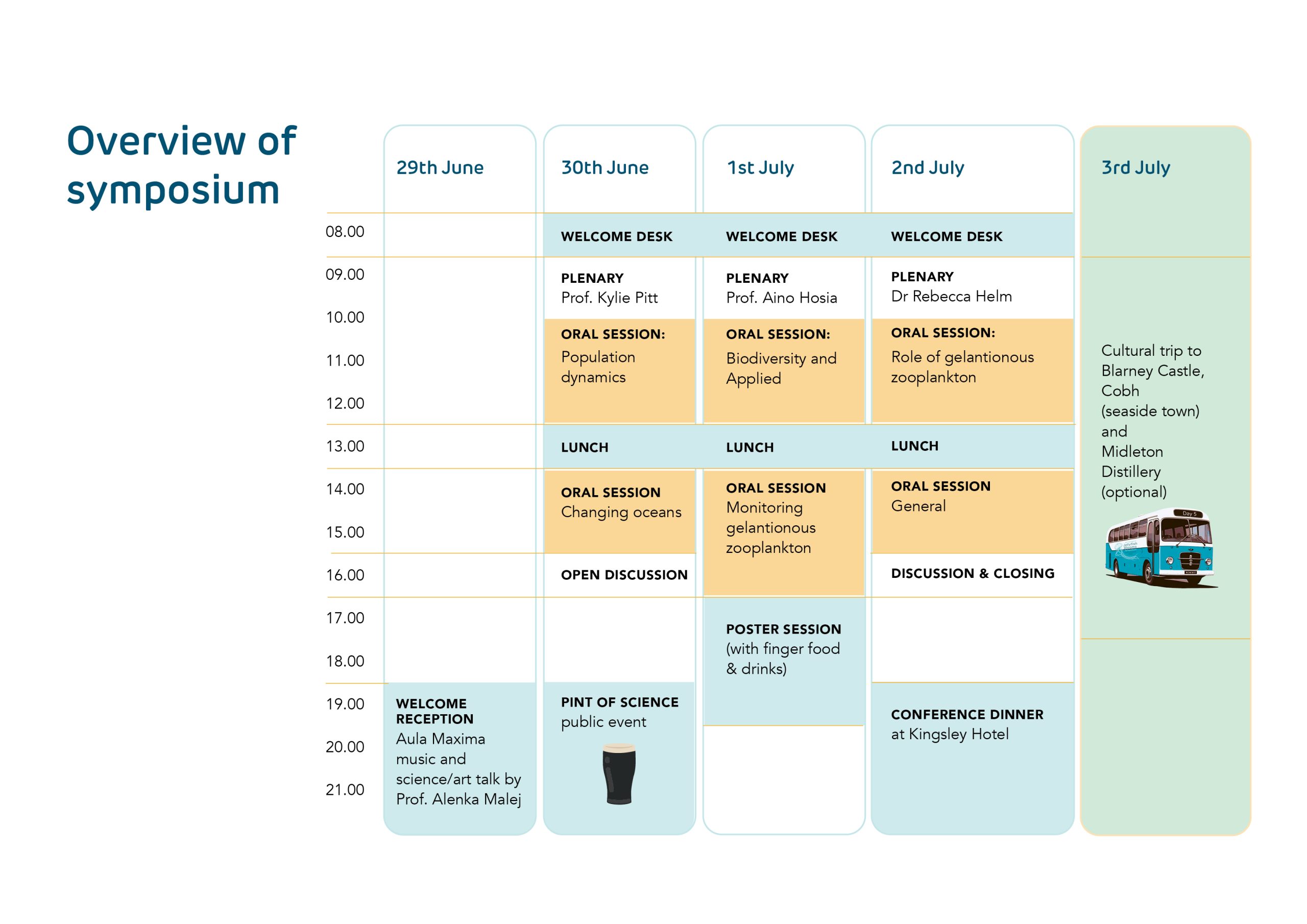
General schedule for JBS8 - click to enlarge
Oral presentations:
To facilitate more oral presentations, all presentations will be 10 minutes long (except plenaries); it is up to the presenter to decide whether to fill the time or leave space for questions. We suggest 8 minutes, followed by 2 minutes for Q&A. To keep sessions running smoothly, moderators will strictly enforce time limits.
- Cover slide: With title of presentation, author names (as provided in the abstract with the name of the presenting author in bold and underlined), and the affiliation of the presenting author (Incorporating the 8JBS logo and the logo of the presenting author’s institute are optional)
- Formatting: Minimum font size on all slides should be 18, as the presentation will be in a large hall
- Media file(s), if any, should be embedded in your primary presentation as a slide
- The meeting will use 16:9 aspect ratio projectors (widescreen). Create your presentation in wide screen format to utilize the full screen
- Please, save the PPT (Power Point, LibreOffice Impress) as a PDF on your computer and bring both formats for the presentation. You can also send them by email: jbs8ireland@outlook.com
Poster presentations:
- Orientation: Portrait, DIN A0 format (84 cm wide x 119 cm high)
- Include the title and authors as mentioned in your abstract.
- Place the 8JBS logo in the upper left corner and the affiliated institution/university logo (if any) in the upper right-hand corner
- Language: English ONLY
- Include the poster Number (to be provided later with the program schedule) at the top middle
- Text should be readable from at least one meter away. Suggested font size is at least 24 points, with author(s) and affiliation(s) at least 42 points, and headings at least 60 points.
----For students, there will be an award of best poster and oral presentation for each theme---
Session topics
Presentations are welcomed on all gelatinous zooplankton under the following broad topics:
- Population dynamics including life histories and polyp biology
- Gelatinous zooplankton in changing oceans, including experiments and analyses of long-term datasets
- Applied jellyfish research, including human interactions, envenomations, jellyfish as food, and biotechnological applications
- Role of gelatinous zooplankton in ecosystems, including trophic interactions, the biological carbon pump, and neuston
- Advancements in studying biodiversity in all ecosystems and functional biology, using traditional and or molecular techniques
- Advances in monitoring, modelling and prediction
- General session
Plenary speakers

Dr Rebecca Helm
Rebecca Helm is a professor of environmental science and marine biologist at Georgetown University's Earth Commons Institute, USA. The Helm Lab focuses on a broad variety of marine biological issues, ranging from the evolution and development of jellyfish, to the ecology of life at the air-sea interface, and the integration of marine science with policy to conserve high-seas biodiversity. Helm is also an active online science communicator, where she explains complex scientific concepts to a broad audience through social media and popular science writing.

Dr Rebecca Helm
Adrift on the high seas: the ecology and biology of cnidarians on the ocean's surface
Adrift on the high seas: the ecology and biology of cnidarians on the ocean's surface
The air-sea interface is one of the largest contagious habitats on Earth, covering over 70% of our planet's surface. This dynamic boundary layer is known as the neustonic zone, and its cnidarian residents sport a wide variety of remarkable adaptations, including living sails, waterproof tissues, and gas filled body cavities, which allow them to drift passively with prevailing winds and currents. Although neustonic cnidarians occasionally wash ashore, their primary habitat is the hard-to-access open ocean, rendering their biology and ecology largely understudied despite global advance in jelly biology generally. In this presentation, I will share our latest efforts to shed light on this ecosystem, including investigations into the environmental and biological drivers of species distribution, the ecological role these cnidarians play in shaping broader neustonic communities, and emerging approaches for detecting and monitoring neustonic cnidarians using Earth-observing satellite technologies.

Professor Alenka Malej
Professor Alenka Malej completed her PhD in Biology at the University of Zagreb in 1984 and spent more than twenty years leading the Marine Biology Station of the National Institute of Biology. Her main research interests include biological oceanography, coastal eutrophication, and plankton ecology. Jellyfish of the Mediterranean Sea have been a key focus of her work since early in her career. Her work has been recognised with several awards and esteemed roles, including the National Science Award, and being Chair of the UNESCO–L’Oréal Committee for Women in Science.

Prof. Alenka Malej
National Institute of Biology, Marine Biology Station Piran, Slovenia
Reimagining Medusa: Myth, Metaphor, and the Role in Marine Systems
Reimagining Medusa: Myth, Metaphor, and the Role in Marine Systems
Jellyfish have traditionally been regarded as beautiful marine creatures yet are often portrayed as ecological stressors and nuisances to human activities. This ambivalent perception mirrors the mythological figure of Medusa, depicted as both beauty and monster, threat and protector. Her meaning has shifted across historical and cultural contexts, providing a compelling metaphor for interpreting the role of jellyfish in marine systems. Our contribution reframes medusae – both mythological and ecological – by integrating contemporary ecological data with artistic interpretations and historical narratives. We examine how evolving cultural perceptions and scientific understandings have transformed Medusa from monster to protector, and jellyfish from symbols of ecological imbalance into dynamic participants in ecosystem processes. Our interdisciplinary approach invites a reconsideration of jellyfish as functional ecological actors in changing marine environments and offers a more nuanced interpretation of how past Medusa narratives have evolved.

Professor Kylie Pitt
Kylie Pitt is a professor and marine ecologist at Griffith University, Australia. Her team’s research focuses on understanding the population dynamics of jellyfishes from local to global scales, their responses to changing ocean conditions, and their interactions with people and coastal industries. Current challenges her team is addressing include using eDNA assays to detect dangerous and invasive jellyfishes, developing a forecasting system for Physalia, and creating computer vision models to detect jellyfish incursions into fish farms. Kylie leads the Griffith Sea Jellies Laboratory, a state-of-the-art jellyfish research facility.

Professor Kylie Pitt
Griffith University, Australia
Changing the narrative around gelatinous zooplankton population trends
Changing the narrative around gelatinous zooplankton population trends
Claims that gelatinous zooplankton are increasing globally persist in the scientific and public discourse. The two seminal studies that attempted to resolve this question, (Brotz et al. 2012; Condon et al. 2013) failed to reach consensus but were limited by the quality, quantity and spatial and taxonomic resolution of the data available at the time. More than a decade later, many more quantitative time series of gelatinous zooplankton have emerged enabling more rigorous and nuanced analyses of global population trends. Recent analyses of this expanded data set, compiled by a global consortium of jellyfish researchers, reveal that gelatinous zooplankton are highly variable, are not increasing globally and that medusae, ctenophores and pelagic thaliaceans exhibit disparate population trends, likely reflecting their differing ecologies and heterogeneous responses to environmental change. Perpetuating claims that gelatinous zooplankton populations are increasing globally could constrain scientific thinking and may channel resources towards unproductive research areas. Here I discuss the need to change the narrative around jellyfish to ensure that we direct resources towards the most pertinent research questions.

Professor Aino Hosia
Aino Hosia is professor in invertebrate systematics and curator of the invertebrate collections at the University Museum of Bergen, Norway. She is broadly interested in the diversity, evolution, and ecology of ctenophores and medusozoan cnidarians. Ongoing work by her team applies integrative morphological and molecular methods to address a variety of questions regarding taxonomy and systematics, faunistics and phylogeography, population genomics, life cycles, species interactions, as well as metabarcoding for diet and eDNA studies. Working at a museum, Aino is also passionate about scientific collections, and for the past decade, her team has worked extensively on DNA-barcoding and building reference libraries for jellies.

Professor Aino Hosia
University of Bergen, Norway
A decade of reference sequencing jellies
A decade of reference sequencing jellies
For over a decade, our team has been building DNA reference libraries for medusozoan cnidarians and ctenophores, particularly focusing on hydrozoans in the northeastern Atlantic, the Arctic, and the Antarctic. The accumulated vouchered sequence data not only facilitate the molecular identification of gelatinous predators but also provide an invaluable resource for taxonomic and ecological research, contributing to the identification of cryptic species complexes and resolution of complex life cycles, as well as the improved understanding of phylogenies, distribution patterns and trophic interactions. Despite the improved taxonomic coverage of reference libraries, systematic biases persist when applying molecular methods of diversity assessment to gelatinous predators. Systematic differences in taxonomic representation remain, due to limited access to specimens and difficulties in sequencing standard markers for selected taxa. Even when reference sequences are available, systematic primer-template mismatches can bias current metabarcoding results. To tackle these shortcomings, we are transitioning from Sanger sequencing to genomic approaches providing multiple markers and entire mitogenomes, as well as additional data at genomic scale. The data generated offer expanded opportunities for future applications, but are not without their challenges, particularly related to data management and sustainable bioinformatics pipelines. Joint efforts by the global community of gelatinous zooplankton researchers are encouraged as the key to continued accumulation and improved taxonomic, geographic and genomic coverage of openly available reference sequence data.
Organising committee
The 8th International Jellyfish Blooms Symposium is being organised and hosted by Dr Tom Doyle, Dr Cathy Lucas, Dr Mary Beth Decker, Dr Delphine Thibault, Dr Valentina Leoni, and Dr André Morandini.
Guidelines for presentations (oral and poster)

Image by Alvaro E. Migotto

Image by Kerstin Peters
All abstracts will be reviewed by an international panel of experts and selected for oral/poster presentations. After abstract acceptance, the author who will present must register by paying the required registration fee, and only those who have registered for the conference will be allowed to attend. A person can give only one talk but may present multiple posters.
- Language: English
- Number of words: 250 max.
- Font: Times New Roman
- Font size: 12pt
- Line spacing: 1
- Format: MS Word or LibreOffice Writer
- Title (Times Roman 14 bold) (No Capitalized letter except, when necessary; be careful, species name needs to be in italic)
- Authors name with superscript number for addresses, presenting author in bold
- Authors’ Addresses and email for corresponding author
The abstract should indicate the abstract type (oral/poster). However, the committee may modify the format during the selection process of the submissions
© JBS8 | Powered by WebHero | Jellyfish background image by